
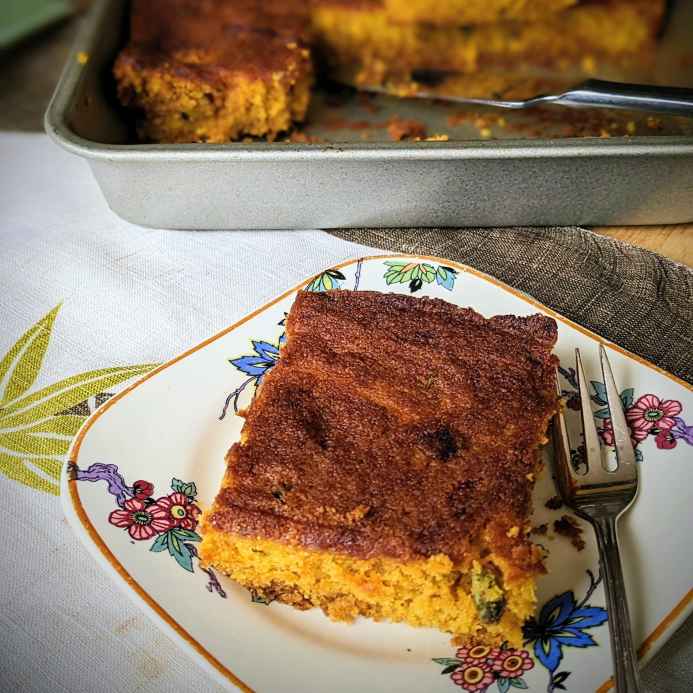
Vegetarian mango cake
The beginning of summer and mangoes is a sacrosanct relationship! It motivated us to accept the scorching heat of summers in India. Although then, my birthplace, Pune, was a cool haven with small bungalows and wide canopies of trees. Gujarati and Maharashtrian homes celebrate the arrival of Hapus – Alphonso mango and Payari mangoes. My granny hailed from Gujarat, while my mother grew up in Maharashtra. Our house was a blend of both cuisines.
Hapus, warm and heavy in the hand, sweet as honey, rich and creamy as an avocado, was eaten sliced, while Payari, with a hint of sour and a slightly less creamy texture, was reserved to make aamras (sieve-strained smooth pulp) to be eaten at lunchtime. Semi-ripe Hapus was also used in our family to make a preserve, with mango cubes called Moramba, laced with cardamom and saffron. This was reserved as a special treat for guests and us. A large crockery jar, the top covered with a muslin cloth, helped preserve the Moramba till the next season.
Some family recipes get handed down through generations; this Ambyachi ravoli is one of those. You might call it a mango cake. This eggless recipe, with very few ingredients that are easy to remember till you go old; no one writes it down. We did not have an oven till the late 1960’s; the Ambyachi ravoli was baked in a large heavy kadhai (wok) with hot sand in it. Hot embers were also spread on the lid of the pan to give a constant heat from the top. Now an oven simplifies the baking.
The rich golden colour, an intense fragrance that pervades the house, and the unctuous creamy taste are the experiences I wish to share with you. Every morsel evokes memories of summer, warm ripe Hapus (Alphonso mango), and my granny serving the ravoli to us, eagerly waiting siblings. It took all her hiding tricks to keep us away from stealing it from the kitchen.
In countries where the fresh Alphonso is unavailable, use the tinned pulp. Reduce the proportion of sugar in that case. This recipe can be adapted to other fragrant fruits-using ripe apricots or jackfruit pulp. Reduce sugar to 1/2 cup.
1 cup= 240 ml/ 1 tbsp = 15 ml/ 1 tsp = 5 ml
| ¾ cup ghee or Beurre noisette | |
| ¾ cup fine crystal sugar | |
| 1 cup Alphonso mango pulp | |
| 1 cup fine semolina / Italian pasta semolina + a pinch of salt | |
| 1 tbsp full-fat yoghurt | |
| 1 tsp level-soda bicarbonate | |
| ½ tsp cardamom powder | |
| A generous pinch of saffron crumbled (optional) |
The most flavourful cake you will ever taste!
| 1. | Preheat the oven to 180⁰ C. Line a 22x22 cm sq or 23 cm Ø baking tin with greased parchment paper at the base; grease the sides with ghee. |
| 2. | In a mixing bowl, using a whisk, beat the ghee and sugar together till light in colour. |
| 3. | Add the mango pulp and mix well. |
| 4. | Whisk as you add the semolina and mix thoroughly. |
| 5. | Add the cardamom or saffron and mix in. |
| 6. | Just before baking, mix in the yoghurt and the soda bicarbonate with a whisk. |
| 7. | Pour into the baking tin, tap once or twice on the work surface to set it evenly in the tin. |
| 8. | Bake for an hour in the middle rack of the oven; the top should be golden, and a skewer inserted should come out clean. Check after 45 minutes to avoid overbaking. |
| 9. | Remove from the oven; cool the tin placed on a rack for at least 2 hours. |
| 10. | Store in an airtight box for 3 days or up to a week on the top shelf of the fridge. |
Leave a Response